Monthly Statistics
During March the Metron Project added the following to its database:
- Users: 164
- Issues: 1,107
- Creators: 36
- Characters: 240
Thanks to everyone that contributed!
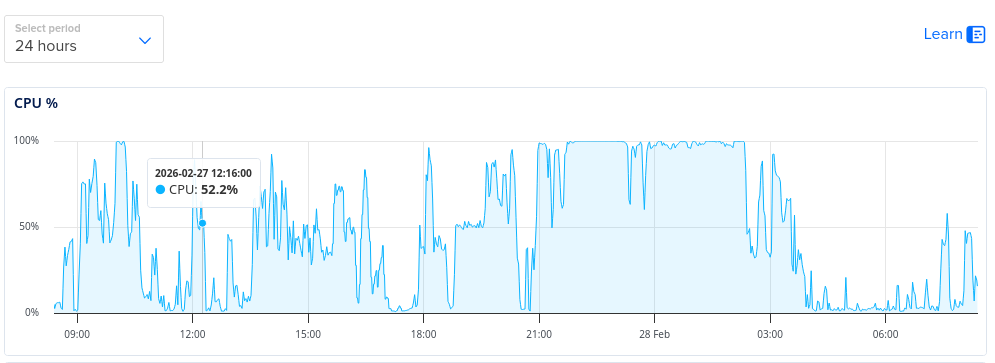
API Rate Limit Reduction
Early in March, we reduced the API rate limits due to increased server load from growing API usage. The new limits are:
- 20 requests per minute (down from 30)
- 5,000 requests per day (down from 10,000)
Updated releases of Mokkari and Metron-Tagger were published to reflect these changes. If you consume the API directly, make sure your code handles HTTP 429 responses and respects the Retry-After header. If we receive enough donations to cover a server upgrade, we would look at restoring the daily limit to 10,000 requests per day.
Website
Here's a summary of everything that landed in the website since the start of March, covering API improvements, reading list enhancements, collection stats, and a handful of performance and bug fixes.
API Improvements
Rate Limit Changes and Visibility
The API rate limit was adjusted to 20 requests/minute and 5,000 requests/day. To make this more transparent, the API now returns rate limit response headers on every response, so clients can see exactly how many requests they have remaining. Users can also see their current daily API usage — requests used, remaining, and a color-coded progress bar — directly in their profile's Account Settings section.
Conditional Request Support
Two more endpoints now support conditional requests (ETags / If-None-Match):
- The reading list detail endpoint — item add/remove operations now bump the parent list's
modified timestamp, so clients can detect item changes without polling /items/.
- The
/issue_list/ endpoints — thanks to Jonas Stendahl for this contribution.
This means clients can avoid re-downloading unchanged data, saving bandwidth for both users and the server.
Reading List Enhancements
The ReadingList model and API received several new additions:
list_type field — exposed in both the list and detail serializers, with human-readable display values.image field — reading lists can now have a cover image. When set, the reading list detail page displays a semi-transparent hero header using the image; it falls back to the plain header when none is present.
Bug Fixes
- Fixed a
PATCH request to SeriesViewSet that was silently clearing the imprint field when it was omitted from the request body.
- Fixed the
ReadingList unique constraint to include attribution_source, allowing a user to have multiple lists with the same name as long as they come from different sources.
Reading List Web Views
- Added a publisher filter to the reading list view, available in the Advanced Filters panel.
- Fixed an issue count display bug in
ReadingListListView.
- Fixed a slow query in the publisher filter — the previous JOIN-based approach caused ~30 second response times on live data. We implemented a subquery-based approach is 5.6x faster.
Collection Stats
- Added Top Writers and Top Artists horizontal bar charts to the Collection Stats view.
- Fixed chart text readability in dark mode — chart tick labels, grid lines, legend text, and titles now follow Bulma's theme-aware colors rather than Chart.js's hardcoded defaults.
General UI / Frontend
- Cover images in issue detail pages and card grids now handle landscape-oriented covers correctly. Instead of forcing all covers into a portrait
2by3 aspect ratio with a center crop, the template detects the aspect ratio of the generated thumbnail and uses is-3by2 for landscape images and is-2by3 for portrait.
- Replaced
prefetch_related with select_related in HomePageView for recently edited issues, reducing two extra queries to a single JOIN.
- Eliminated unnecessary series type queries in several views — thanks to Jonas Stendahl for this contribution.
- Fixed issue count annotations not appearing in
PublisherSeriesList and ImprintSeriesList card grids.
Bug Fixes
- Fixed an autocomplete widget crash (Internal Server Error) on create/update views when submitting a form without selecting an autocomplete field value. A
SafeAutocompleteWidget subclass now normalises empty string and empty list values to None before the upstream widget tries to filter on them.
Dependency Updates
- Updated to Django 5.2.12.
- Updated Pillow.
Contributors
Thanks to Jonas Stendahl for his contributions this month.
Mokkari
Here's a summary of everything that landed in Mokkari during March, covering rate-limiting overhaul, new schema fields, and dependency refreshes.
Rate Limiting Changes
Reduced API limits
The per-session rate limits were updated to match the current Metron website limits:
| Limit | Old | New |
|---|
| Per minute | 30 | 20 |
| Per day | 10,000 | 5,000 |
Pluggable rate-limit buckets
Session and the top-level api() function now accept an optional bucket parameter typed as AbstractBucket from pyrate_limiter. This lets you plug in any compatible backend — Redis, a database, or a plain in-memory store — to share rate-limit state across multiple workers or processes.
The default behaviour is unchanged: a SQLite-backed bucket is created lazily and shared across all sessions in the same process. A DEFAULT_RATES constant is now exported from mokkari.session so you can construct custom buckets with the same rate definitions:
from pyrate_limiter import RedisBucket
import redis
import mokkari

pool = redis.ConnectionPool.from_url("redis://localhost:6379")
bucket = RedisBucket.init(mokkari.session.DEFAULT_RATES, redis.Redis(connection_pool=pool), "mokkari")
m = mokkari.api("username", "password", bucket=bucket)
Contributors
Thanks to Myers Carpenter for his initial work on the pluggable rate-limit buckets this month.
Reading List Schema Additions
Two new fields were added to the reading list schemas:
image — an image URL field on ReadingListRead, surfacing the cover image for a reading list.list_type — a new field on the reading list schemas that exposes the list's type classification.
Metron-Tagger
Here's a summary of everything that landed in Metron-Tagger during March, covering rate limit improvements, bug fixes, and dependency updates.
Rate Limit Handling
The tagger's handling of Metron API rate limits was improved:
- Clock-skew buffer — A
RATE_LIMIT_RETRY_BUFFER constant (2 seconds) is now added to every retry_after wait to account for small differences between the client clock and the server clock, reducing the chance of hitting the limit again immediately after waking up.
- Nested rate limit handling — If a second rate limit error is encountered during a retry attempt, the tagger now performs one additional silent wait-and-retry instead of surfacing an error to the user. Only if that second retry also fails is an error reported.
These changes result in fewer spurious rate-limit errors when tagging large batches of comics (#238).
Bug Fixes
- Fixed a crash that occurred when a MetronInfo file did not include an
info_source field. Previously, iterating over md.info_source without checking for its existence would raise an exception. The fix adds an early None guard in get_id_from_metron_info so files without a source are silently skipped rather than crashing the tagger.
Dependency Updates
- Updated the Mokkari dependency to pick up its latest improvements.
Contributors
Thanks to @bearinfo for his contributions this month.
Desaad
During March several new features around content discovery, reading list management, and library gap tracking were made.
Creator Views
Creators now have their own browsable pages. A new Creators section in the navigation gives access to a full creator list and individual detail pages showing a creator's roles across your library. A dedicated Creator Series/Issues view lets you drill down into their work by series.
Bookmarks
You can now bookmark series and issues directly from the list views. A bookmark icon overlays the cover image; clicking it toggles the bookmark state inline via HTMX without a page reload. A new Bookmarks page collects all your saved items in one place, with inline unbookmark support.
Advanced Search for Series and Issues
The Series and Issue list views gained advanced filtering capabilities. You can now filter by multiple criteria simultaneously, making it much easier to navigate large libraries.
Reading List Refresh with Conditional Requests
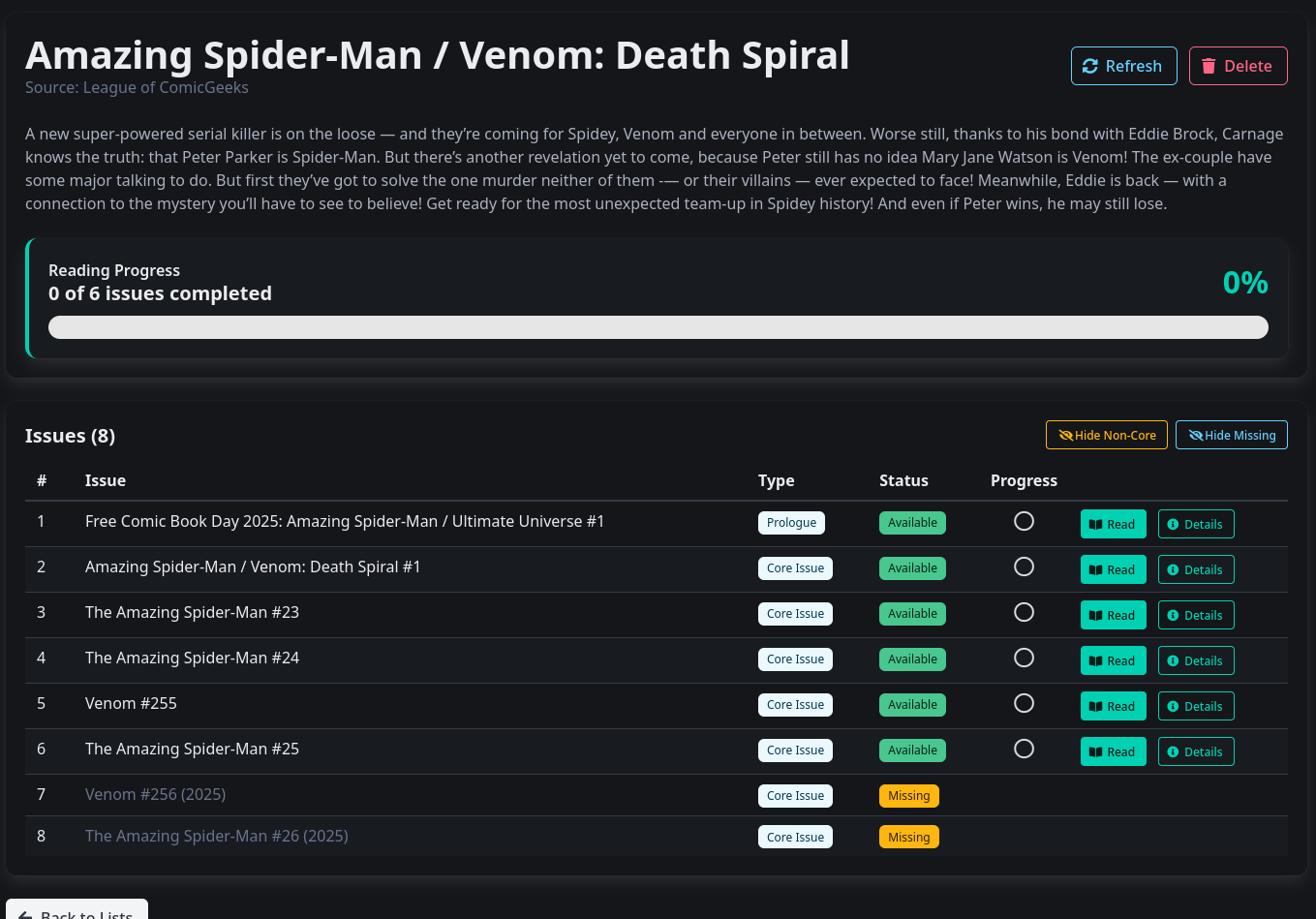
Reading lists sourced from Metron can now be refreshed. Desaad stores the modified datetime returned by Metron and uses it on subsequent refresh requests via If-Modified-Since. If Metron returns 304 Not Modified, you'll see an "already up to date" message. Otherwise, existing items are cleared and a background re-import is enqueued. A Refresh button appears on the detail page for any Metron-sourced list with a completed import.
Series Missing Issues Tracking
Desaad can now check your local library against Metron to identify issues in a series that you don't yet have. A new MissingSeriesIssue model tracks these gaps, and a Check Missing Issues button on the series detail page triggers the check inline via HTMX. Like reading list refresh, subsequent checks use conditional requests — if nothing has changed on Metron's side, you'll see an "already up to date" response.
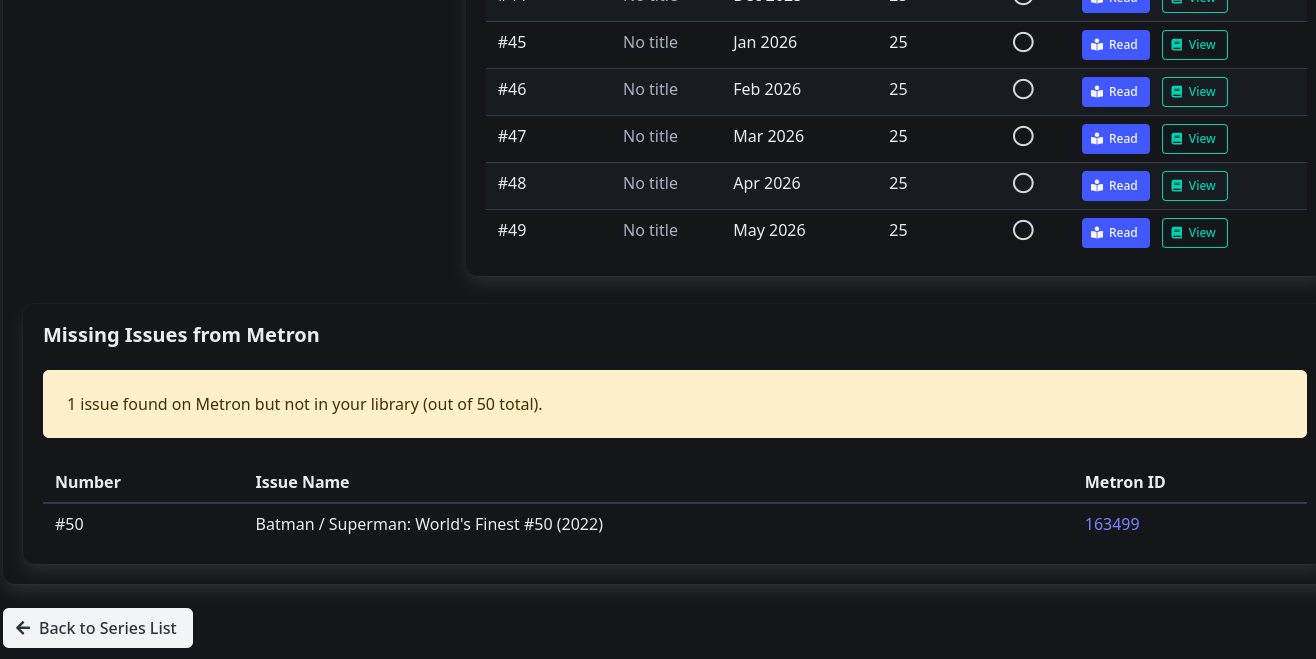
A dedicated Missing Issues list view provides an overview of all tracked gaps across your library, and a background task automatically cleans up missing issue records when you import a previously absent issue.
Reading List Improvements
Reading list search results and detail pages now show human-readable attribution source labels. Issue type display and filtering were added to reading list items, and attribution source tags appear on reading list cards for quicker at-a-glance identification.
OpenCollective
A huge thank you to everyone who has contributed to our Open Collective! Your support makes a real difference in keeping the Metron Project running and growing.
What Your Contributions Support
Funds from Open Collective go directly toward:
- Server hosting costs - Keeping the Metron website and API available
- Domain registration - Annual domain name renewals
- Future capacity increases - Scaling resources as the database and user base grows
All expenses are transparent and publicly viewable on our Open Collective page, so you can see exactly where every dollar goes.
Support the Project
If you'd like to help keep the lights on and support continued development, contributions of any size are appreciated and help ensure Metron remains a free resource for the comic book community.
Anyway, that's everything for this month! Take care.